History
The Koninklijke Steltenlopers van Merchtem conquer the world
Some customs and practices survive in the leisure life of a region. This creates a form of folklore, allowing future generations to discover the past in an engaging way. Walking on stilts was once a necessity, but today it is a fun form of recreation. Not only in Europe, but elsewhere too, people started walking on stilts. In China, Japan, and Polynesia, it was part of popular culture. In America, the sandwichman is an example. All these forms of stilt walking have a varied history.
To understand stilt walking in Brabant, we must also look to the past. Within this centuries-old tradition, the now world-famous folkloric association “De Steltenlopers van Merchtem” emerged, gaining international fame and a global record over the years.
In the past, people used stilts to cross rivers or stay dry during floods. They were probably used worldwide until more modern tools were invented. Witnesses from the past include the stilts walkers of Namur on the Meuse River. Since the 18th century, stilts walkers were reported in the marshlands of the Landes in southern France. Stilts were also used for work that was difficult to reach. In construction, plasterers used stilts. In Kent, southern England, hop growers used stilts to tie wires to tall poles. Shepherds in various countries used stilts to move among their flock, gaining a better overview.
Stilt walking as part of a profession disappeared with modern tools, but it persists as a children’s game and folk sport. In folklore, stilts walkers appear through the centuries in parades and circus life. The desire to be taller than others manifests in this way, seen with the sandwichman in America, wizards among Bantu peoples, and the first giants in Flemish cavalcades…
Stilt walking in Merchtem and Brabant over the centuries
In Brabant, stilt walking also has a very long tradition. Archives show that it was known in our region as early as 1336. At the start of the 16th century, the miniaturist Simon Bening (°1483/1484) depicted four stilts walkers. This miniature, showing a stilt fight, is in the Book of Hours (1505) of Philip the Fair (kept in Valencia). The Flemish painter Pieter Bruegel the Elder shows two stilts walkers in his famous painting “Children’s Games” (1560), depicting 81 different folk games. Our stilts walkers still wear the costumes of that era, adapted to the Belgian tricolor.
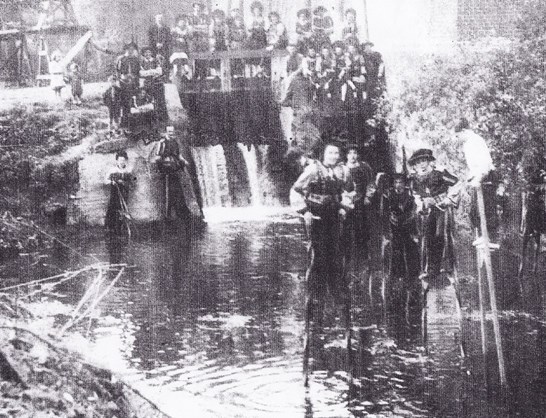
The Molenbeek, a wide but shallow stream, runs through Langevelde, a hamlet of Merchtem, before joining the Willebroek canal at Ruisbroek, sixteen kilometers away. When it flooded, locals used stilts to cross the marshy areas. In winter, they used sliding boards. They wore blocks as shoes, explaining the “blokkenlopers” among the Koninklijke Steltenlopers.
The foundation of the Steltenlopers van Merchtem
During World War II, leisure opportunities in occupied Belgium were limited. People began organizing local entertainment and reviving old games. The youth of Langevelde started stilt walking, followed by adults from 1942. They made stilts from ash and willow wood, reaching one to three meters. A healthy competition emerged to walk higher and higher. The stilts walkers began holding mock fights purely for sport.
On June 10, 1945, a Liberation parade went through Merchtem. Each district participated. Instead of building a float, the residents of Langevelde deployed 25 elegantly dressed stilts walkers from five families: Van Hoeymissen, Van Den Broek, Cooremans, Walravens, and Meysman. Spectators were amazed and the performance was highly successful.
A few days after the parade, the Folkloric Association Steltenlopers van Merchtem was founded. The founder and first chairman Jan Vanderhasselt (°Merchtem, 11/09/1907 - †Ekeren, 01/06/1979) and his first wife Jeannette Van Der Slagmolen (°Asse, 28/11/1911 - †Merchtem, 07/11/1968), along with Florent, Jules, and Victorine Van Hoeymissen, developed the association.
After the successful performance in the Merchtem Liberation Parade, the group was invited two weeks later to a Peace Parade in Wemmel. In February 1946, they performed in the Aalst Carnival Parade, where the Merchtem stilts walkers were honored as laureates. The future was secured and invitations kept coming in.